Chapter 05 · 10 min read
Panch Bhoota Sthalams
Shiva as the Five Elements
Sacred Waters · September 2026
Before we named the world around us, we were already part of it. Earth beneath our feet. Water moving through rivers. Fire warming and transforming. Air entering our lungs. Space holding everything together. Across Indian philosophical traditions, these five elements have long been understood as fundamental aspects of the material world. In Shaivism, this idea takes a deeply sacred form through the Panch Bhoota Sthalams five temples in South India where Lord Shiva is worshipped in association with the five great elements, or Pancha Bhoota. Earth. Water. Fire. Air. Space.
Five elements. Five temples. One extraordinary way of understanding Shiva through the natural world. But the Panch Bhoota Sthalams are not simply a collection of ancient temples. They offer a different way of travelling. Instead of asking only, Where does Shiva reside?, the pilgrimage invites another question. How do we experience the divine through the world around us? What Are the Panch Bhoota Sthalams?
The Sanskrit expression Pancha Bhoota refers to the five great elements traditionally understood in Indian philosophy. Prithvi (earth), Jala or Apas (water), Agni (fire), Vayu (air) and Akasha (space/ether). The Panch Bhoota Sthalams are five sacred Shiva temples in Tamil Nadu and Andhra Pradesh traditionally associated with these elements. They are:
Ekambareswarar Temple, Kanchipuram Earth (Prithvi)
Jambukeswarar Temple, Thiruvanaikaval Water (Jala)
Arunachaleswarar Temple, Tiruvannamalai Fire (Agni)
Srikalahasti Temple, Srikalahasti Air (Vayu)
Thillai Nataraja Temple, Chidambaram Space (Akasha)
Together, they form a sacred geography in which Shiva is experienced not only through an image or temple, but through the elemental nature of existence itself. It is an idea that feels both ancient and surprisingly immediate. Because the elements are not abstract. We experience them every day. We stand on earth. We drink water. We feel warmth. We breathe air. We live within space. The pilgrimage simply asks us to notice them differently.
Earth Ekambareswarar Temple, Kanchipuram
The journey begins with Earth. In Kanchipuram, the Ekambareswarar Temple is traditionally associated with Shiva as the element of Prithvi, or earth. The temple is connected with a powerful legend involving Goddess Parvati. According to tradition, Parvati worshipped Shiva beneath a sacred mango tree and created a Shiva lingam from earth. The story brings together two forms of devotion. The physical act of shaping earth.
And the spiritual act of worship. Earth is usually something we overlook. We walk on it without thinking. We build our homes on it. We grow food from it. We bury what we no longer need within it. It supports us constantly without demanding our attention. Perhaps that is why earth makes such a fitting symbol for Shiva. It reminds us of grounding. Of stability. Of the physical world from which life emerges.
Standing in an ancient temple surrounded by stone, carved pillars and the living rhythms of worship, the idea becomes tangible. The sacred is not somewhere far away. It is beneath your feet.
Water
Jambukeswarar Temple, Thiruvanaikaval
From earth, the journey moves to water. At Jambukeswarar Temple in Thiruvanaikaval, near Tiruchirappalli, Shiva is traditionally worshipped as the element of water. The temple is associated with an underground water source that is traditionally understood as part of the shrine's sacred character. Water has a particular emotional power in Indian pilgrimage traditions. We seek rivers. We bathe before worship. We carry sacred water. We make offerings beside lakes and streams. Water cleans. Water nourishes.
Water changes shape. It flows around obstacles rather than always confronting them. There is something deeply human about standing near water when life feels uncertain. We watch it move. We become quieter. Perhaps that is one reason sacred water appears again and again in pilgrimage traditions. At Jambukeswarar, the element is not simply something outside the temple. It becomes part of the sacred experience.
Fire
Arunachaleswarar Temple, Tiruvannamalai
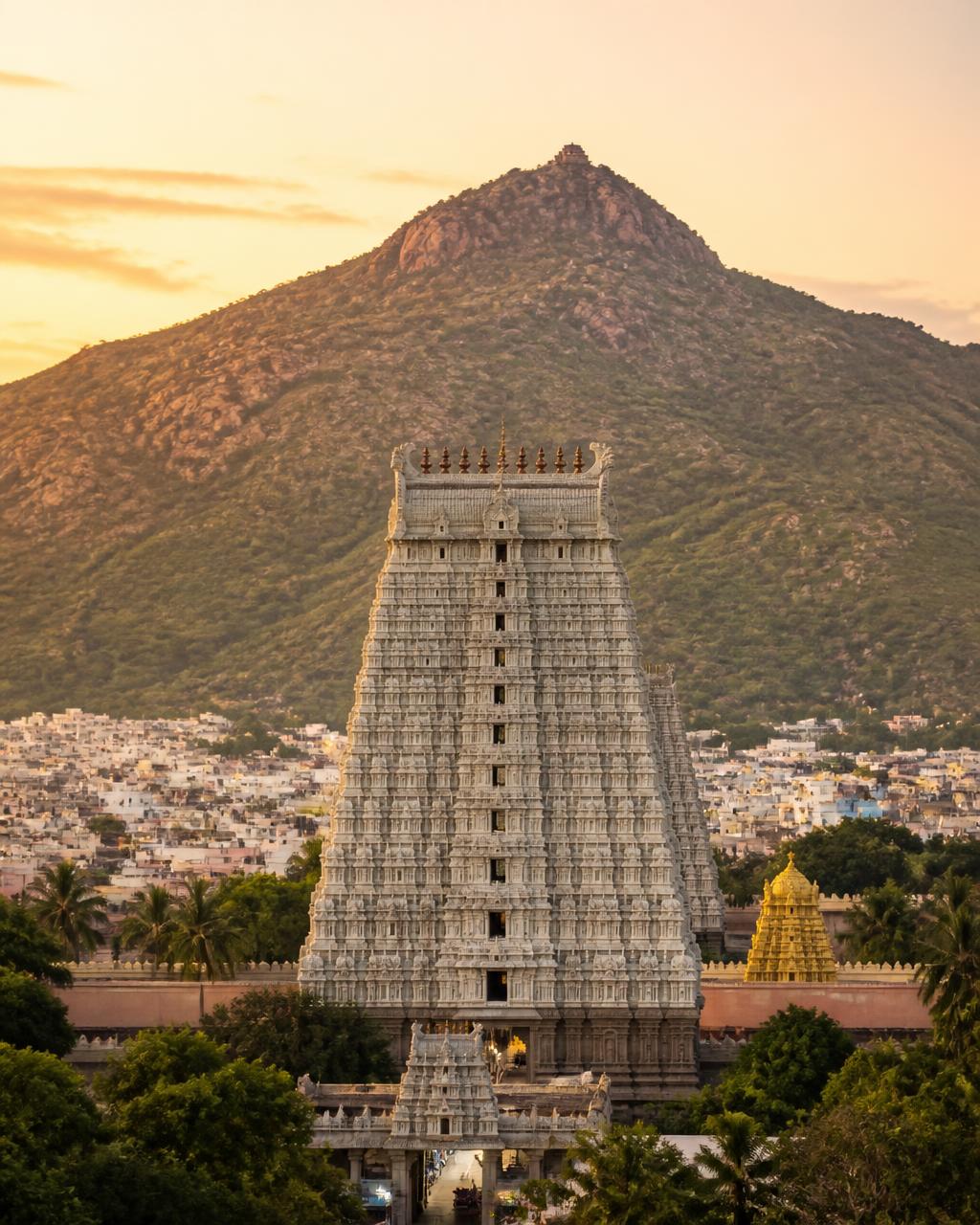
Then comes fire. In Tiruvannamalai, the magnificent Arunachaleswarar Temple is associated with Shiva as Agni, the element of fire. The temple stands at the foot of Arunachala Hill, which itself is regarded as a sacred manifestation of Shiva within the tradition. The story associated with Arunachala is connected to the same idea of Shiva appearing as an infinite column of light. Brahma and Vishnu are traditionally said to have attempted to find its beginning and end.
They could not. The infinite light became associated with Arunachala. Here, fire takes on a meaning beyond physical flame. Fire transforms. It consumes. It illuminates. It can destroy what is no longer needed and create the conditions for something new. Human beings have always gathered around fire. We cook with it. We warm ourselves beside it. We light lamps before deities. We use flame in ceremonies. A single lamp in a dark room can change the entire atmosphere.
That is perhaps why fire works so powerfully as a spiritual symbol. It represents illumination. The movement from darkness towards understanding.
The Experience of Arunachala
For many pilgrims, Tiruvannamalai is not only about entering the temple. The mountain itself is central to the experience. The traditional practice of Girivalam, or circumambulation of Arunachala Hill, draws pilgrims around the mountain. On full moon nights, large numbers of devotees undertake this journey. The road becomes filled with people. Some walk silently. Some pray. Some chant. Some walk with family. Others travel alone. Everyone has their own reason. The mountain does not ask them to explain it.
It simply remains. This is one of the most beautiful aspects of pilgrimage. Thousands of people can undertake the same ritual while experiencing something completely personal.
Air
Srikalahasti
The fourth element is air. At Srikalahasti Temple in Andhra Pradesh, Shiva is traditionally associated with Vayu, the element of air. Air is perhaps the most invisible of the five elements. We cannot see it directly. Yet we know it is there. We feel it against our skin. We watch leaves move because of it. Most importantly, we breathe it. And because breathing happens automatically, we rarely think about it. Until we cannot. This makes air an unexpectedly powerful spiritual symbol.
The breath connects the body to the world outside it. Every breath is an exchange. We take something from the world. We give something back. We are constantly connected to our surroundings, whether we notice it or not. At Srikalahasti, this invisible element becomes part of the sacred imagination. Shiva is experienced through something that cannot be held. Something present precisely because it is unseen.
Space, Chidambaram
The final element is perhaps the most difficult to understand. Akasha. Space. At Thillai Nataraja Temple in Chidambaram, Shiva is associated with Akasha, the element of space or ether. The temple is famous for its association with Shiva as Nataraja, the cosmic dancer. The idea of space is different from the other elements. You can touch earth. You can feel water. You can see fire. You can feel air. But space? It surrounds everything. It is defined partly by what it allows to exist within it. This gives the Chidambaram tradition an extraordinary philosophical depth.
The sacred does not necessarily have to appear as something visible. Sometimes what is absent is itself meaningful.
The Chidambaram Rahasyam
One of the most significant ideas associated with Chidambaram is the Chidambaram Rahasyam, traditionally understood as a revelation of the formless aspect of Shiva. The temple's worship therefore holds together two seemingly opposite ideas. The visible. And the invisible. Nataraja is visible. The sacred space associated with Akasha points towards what cannot be seen. This can be a powerful idea for a traveller. We often think we need to see something to believe that it exists.
But some of the most important things in our lives cannot be photographed. Love. Memory. Silence. Absence. Faith. Perhaps the Chidambaram tradition invites us to make room for what cannot be easily explained.
Five Elements, Five Ways of Experiencing the Sacred
The Panch Bhoota Sthalams can be understood as a journey through five elemental experiences. Earth asks us to become grounded. Water asks us to flow. Fire asks us to transform. Air asks us to breathe. Space asks us to make room. This is not necessarily how every devotee interprets the pilgrimage. Faith is personal. But as a traveller, these elemental associations offer a beautiful framework through which to understand the five temples.
Instead of simply asking what each temple looks like, you can ask what it represents. How does it feel? What does the landscape tell you? What does the ritual reveal? What has this place meant to generations of people?
The People Who Keep the Elements Sacred
A pilgrimage can easily become a story about temples and mythology. But temples do not exist without people. Priests perform rituals. Families maintain traditions. Musicians preserve devotional practices. Artisans restore and care for temple spaces. Pilgrims return year after year. Children learn from parents. Festivals bring entire communities together. These people are part of the pilgrimage story.
When you enter one of these temples, you are entering a place that is already meaningful to someone else. That deserves respect. A visitor may see architecture. A devotee may see home. A traveller may notice a ritual. A family may see a tradition that has been part of their lives for generations. Both perspectives can exist. But the visitor should remember which one came first.
Travelling the Panch Bhoota Sthalams Respectfully
The Panch Bhoota temples are living places of worship. That means a meaningful visit requires more than knowing where each temple is located. Learn the basic customs before arriving. Dress appropriately. Follow temple instructions. Respect restrictions on photography. Avoid interrupting rituals. Ask permission before photographing people. And give yourself enough time to observe rather than simply moving from one site to the next. The purpose of cultural travel is not to consume another culture. It is to encounter it with curiosity and humility.
A Different Way to Travel
Most journeys are organised around destinations. Where are we going? How long will we stay? What will we see? The Panch Bhoota Sthalams offer another possibility. Instead of organising the journey only around geography, organise it around experience. Earth. Water. Fire. Air. Space. Suddenly, the temples become connected by something larger than a route. You begin to notice the landscape differently. The river beside one temple. The mountain near another. The flame during a ritual. The movement of air. The silence inside a sacred space. The journey becomes less about collecting five temples and more about paying attention to the world.
The Elements Are Already Within Us
Perhaps the deepest reason this pilgrimage remains meaningful is that the five elements are not only outside us. They are also part of our own physical existence. We are made of the same world we travel through. We depend on water. We breathe air. Our bodies return to earth. We generate and experience heat. We occupy space. The distinction between the pilgrim and the landscape therefore begins to feel less absolute. We are not simply visitors moving through nature. We are part of it.
That realisation can be surprisingly humbling.
What the Pilgrim Carries Home
Eventually, the pilgrimage ends. You leave Kanchipuram. You leave Thiruvanaikaval. You leave Tiruvannamalai. You leave Srikalahasti. You leave Chidambaram. But the elements come home with you. You still stand on earth. You still drink water. You still feel warmth. You still breathe. You still live within space. Perhaps the pilgrimage has simply taught you to notice them. And perhaps that is enough. The Panch Bhoota Sthalams do not ask us to look for the sacred somewhere impossibly distant. They offer another idea. That the sacred can be present in the most fundamental things we encounter every day. In the ground beneath us.
In the water we drink. In the fire that gives light. In the breath that keeps us alive. In the space that holds us. Five temples. Five elements. Five ways of approaching Shiva. But ultimately, one reminder: The world around us is not merely something we travel through. It is something we are part of. And sometimes, a pilgrimage simply teaches us how to see it again.